


Abbe’s number is a measure of light dispersion.
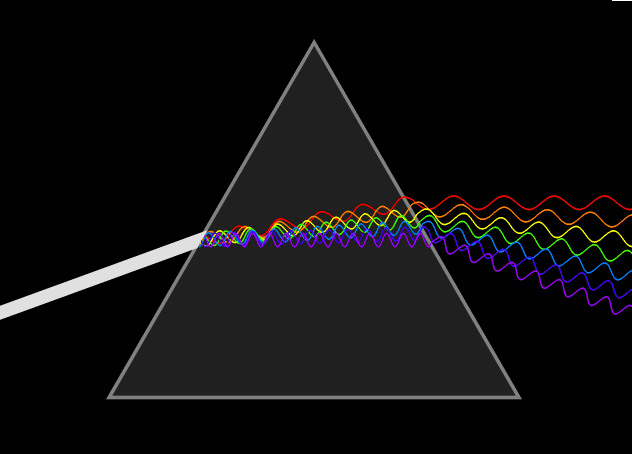
If the spectrum creation experiment is performed on two, geometrically exactly the same prisms, i.e. prisms with the same refractive angle, but made of two types of glass, for example one made of crown glass, the other made of flint glass, the size of the spectrum will not be the same. A prism made of flint glass will have almost twice as much dispersion as a prism made of crown glass. This phenomenon was explained in his mathematical analysis by Ernest Abbe.
The number is determined by the equation:


n D ,n F ,n C -refractive indices of an optical medium for spectral lines D, F, CFranenhofer spectrum. (respectively they are 589.2nm; 486.1nm; 656.3nm)
The dispersion coefficient or Abbe’s number ranges from 20 for very “dense” flint glasses, over 65 for very “light” crown glasses, to 85 for fluorine crown glasses. Those glasses that have a higher Abbe number have a lower dispersion and vice versa. With lenses, the value of the Abbe number is very important because of the lens error, which we call chromatic aberration. In an effort to reduce chromaticism, the Abbe number must be as high as possible.
 For lenses in commercial use, whether made of mineral or “plastic”, we try to make the Abbe number as high as possible (for lenses, the Abbe number ranges from 30 to 58). Each lens manufacturer has four basic characteristics that determine its quality: refractive index, lens density, UV transmission and Abbe number. With this short lesson on optics, we tried to explain how important it is to know the basics of optics and the meaning of the Abbe number when selling lenses on a daily basis, and to explain why it is better to use a better quality lens.
Author:
prof. Emil Šatalić

