


The word astigmatism (lat. Astigmatismus) means without a point. Astigmatism is an eye error in which the optical system of the eye has different refractive powers in different meridians.
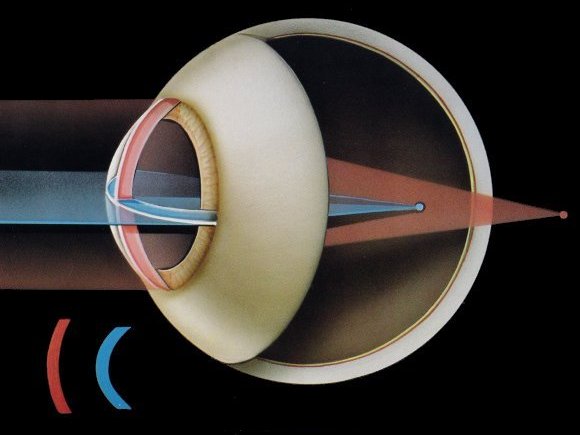
Astigmatism is an eye error in which the optical system of the eye has different refractive powers in different meridians.
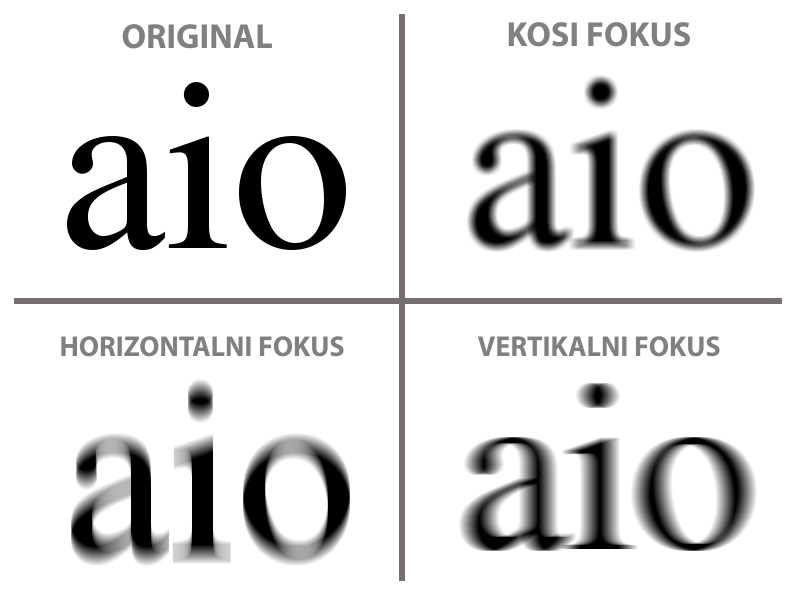
As a consequence, the light rays are not focused in the form of a point but in the form of two lines, which we call focal points, and they are usually perpendicular to each other. An astigmatic eye does not see horizontal and vertical lines equally clearly, so the viewed objects are deformed.
Signs of astigmatism:
- blurred distance and near vision
- headache
- asthenopia (fatigue, burning, etc.)
- head tilt
- tightening of the eyelids
- eyes get tired quickly
Astigmatism is corrected with cylindrical glasses or contact lenses. Nowadays, astigmatism can be corrected surgically (refractive surgery).
Astigmatism can be divided by form and type.
By form, astigmatism is divided into:
Irregular (irregularis):
The main meridians are not at right angles, so the distance between the main meridians is not exactly 90 degrees. Irregular astigmatism cannot be completely corrected with cylindrical glasses or soft contact lenses. Irregular astigmatism is corrected with semi-hard contact lenses
Regular (regularis):
The main meridians are at right angles. Correct astigmatism can be corrected with cylindrical glasses, soft and semi-hard contact lenses.
Regular astigmatism (lat. Astigmatismus regullaris) is divided into:
Vertical astigmatism or astigmatism as a rule (lat. astigmatism rectus):
(I have pictures in an old book, so I’ll post them)
The main meridian of lower refractive power is in a horizontal line, and the main meridian of higher refractive power is in a vertical line. It is corrected with a negative cylinder at 0 degrees.
Horizontal astigmatism or astigmatism against the rules (lat. astigmatismus inversus):
(I have pictures in an old book, so I’ll post them)
The main meridian of lower refractive power is located in a vertical line, and the main meridian of higher refractive power is located in a horizontal line. It is corrected with a negative cylinder at 90 degrees.
Oblique astigmatism (lat. astigmatism obliquus):
(I have pictures in an old book, so I’ll post them)
Both main meridians are in an oblique position, approximately at 45 or 135 degrees. It is corrected with a negative cylinder to approximately 45 or 135 degrees.
According to the type, astigmatism is divided into:
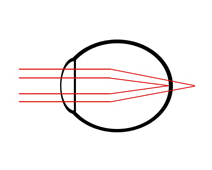
Simple far-sighted astigmatism (lat. Astigmatismus simplex hyperopicus):
One main focal point is located on the retina, i.e. it is emmetropic, and the second focal point is located behind the retina, i.e. it is farsighted.
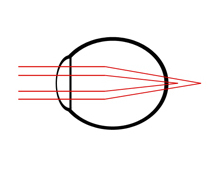
Complex short-sighted astigmatism (lat. Astigmatismus compositus hyperopicus):
Both foci are located behind the retina, i.e. both are farsighted, but unequally.
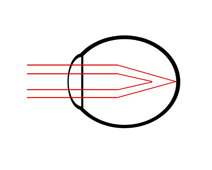
Simple myopic astigmatism (lat. Astigmatismus simplex myopicus):
One main focal point is located on the retina, i.e. it is emmetropic, and the second focal point is located in front of the retina, i.e. it is myopic.
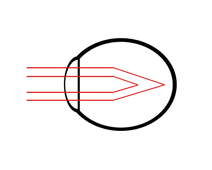
Compound myopic astigmatism (lat. Astigmatismus compositus myopicus):
Both foci are located in front of the retina, i.e. both are myopic, but unequally.
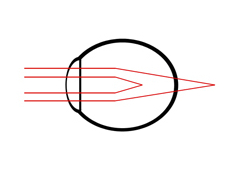
Mixed astigmatism (lat. Astigmatismus mixtus):
One focal point is in front and the other behind the retina, i.e. one is short-sighted and the other is far-sighted.
In order to classify astigmatism, names from both divisions are used in diagnostics.
For example simple farsighted horizontal astigmatism (lat. astigmtismus siplex hyperopicus inversus).
Autor:
bc. Livio Svržnjak, optometrist

