


Putting lenses in your eyes is a skill. Most people find it a bit clumsy at first, but after a few days you’ll probably become an expert.
One pair of contact lenses must not be used by two people!
To successfully fit the lenses in your eyes, follow these steps: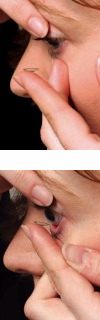
- Before handling contact lenses, wash and dry your hands thoroughly.
- Do not use a contact lens if it is not in the original package or if it has expired.
- Remove the lens from the container.
- If necessary and desired, rinse it with a fresh rinsing solution.
- Make sure it is clean, free of deposits and evenly moist.
- Place the lens on the cheekbone of the index finger of the right hand.
- Pull the lower eyelid of the right eye with the middle finger of the same hand.
- Pull the upper eyelid of the right eye with the middle finger of the left hand.
- You need to catch the eyebrow close to the lashes to make sure you don’t blink too early.
- Look straight into the eye in the mirror and place the lens directly on the iris of the eye.
- Carefully release your eyelids and blink.
- Open your eye and make sure the lens is in the right place.
- Your vision must be clear and your comfort satisfactory.
- If you feel discomfort, there may be a particle of dust on the lens. In this case, it should be removed, rinsed and reinserted into the eye.
- If the vision is not clear, it is possible that the lens is not centered but has moved to the sclera. Close the eye and massage the lens over the eyelid with the cheekbone of the index finger, moving it towards the center of the eye.
- Do the same for the left eye, of course with a change of hands.
Note – Until you become adept at fitting the lenses, place them over a flat surface in case they fall out. Use a mirror. Do not blink too quickly – if the lens is not adjusted properly, it could fall out of the eye.
Removing the lens
For most beginners it is easier! As usual, wash and dry your hands thoroughly. 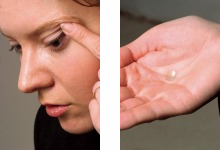
- Prepare everything necessary for lens care after removal: cleaning fluid, rinsing fluid, container.
- To grasp the lens, place a towel or the palm of your left hand under your eye.
- With the right index finger, pull the outer corner (between the upper and lower eyelid) of the right eye, outwards and upwards. Keep your eye open the whole time (don’t squint).
- Blink rapidly. The lens will pop out onto your palm or towel.
Why is it important to store contact lenses in solution?
The care solution in which you put the contact lenses contains a mild but effective dose of disinfectant. Keeping the contact lenses in the solution helps to remove the remaining bacteria and protein deposits from the contact lenses, so that they are clean when they are put on the eyes.
Important!
- Always clean and disinfect your contact lenses as directed, after each contact lens removal.
- If redness or eye irritation occurs, remove the contact lenses and seek the advice of a contact specialist (ophthalmologist or optometrist).
- Avoid contaminating contact lenses with cosmetics, sprays or being in a vaporous environment.
- Replace a damaged, scratched or soiled contact lens immediately.
- Avoid long nails. Scratches on the cornea are prone to infection.
- Keep contact lenses out of the reach of children.
- When playing water sports, always protect your contact lenses with appropriate sports glasses.
- Do not wear contact lenses if you are not feeling well, for example if you have a cold or a virus.
- Put in contact lenses before applying makeup. Remove contact lenses before removing makeup.
- Clean and change the lens container regularly!
Warnings:
- Do not sleep with contact lenses, unless your contact specialist (ophthalmologist or optometrist) has advised you to do so.
- Do not wear contact lenses for longer than the time recommended by your contact specialist (optometrist, ophthalmologist).
- Replace contact lenses with a new pair within the period recommended by your contact specialist (ophthalmologist or optometrist).
- Do not drip eye medication onto contact lenses, unless recommended by an ophthalmologist.
- Do not wet contact lenses with saliva. Saliva contains various microbes that can cause various types of eye inflammation.
- Do not rinse the contact lenses or the contact lens container with tap water or other liquids, but only with contact lens care solution. Water is a carrier of bacteria and other microorganisms that can cause serious eye infections.
Do a self-examination of your eyes every day
Ask yourself the following questions when wearing contact lenses:
Do my eyes feel good?
Do my eyes look good?
Can my eyes see well?
If any answer is negative, take out the contact lens and seek the advice of your contact specialist (ophthalmologist-optometrist).
Author:
bc. Livio Svržnjak, optometrist

