


Emmetropia or normal-sighted eye means the refractive state of the eye in which the far point (Punctum remotum) is at infinity, the point of the clearest vision at a distance. In an emmetropic person, the image of the observed object is projected directly onto the retina and is therefore completely clear.
The distant point (Punctum remotum) is in front of the eye at infinity.
The near point (Punctum proximum) is located in front of the eye, the distance depends on the power of accommodation
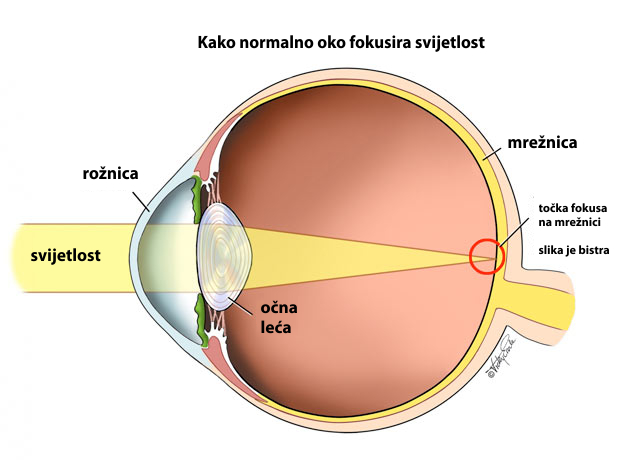
In an emmetropic eye, the dioptric power of the eye and the size of the eye are in the correct relationship, the dioptric power of the refraction system is adequate, and the ocular axis is 24 mm (normal eye).
In other cases, when the image of the observed object is not projected onto the retina, we speak of ametropia (lat. ametropia).
Ametropia can be divided into:
- Myopia (lat. Myopia)
- Farsightedness (lat. hypermetropia)
- Astigmatism (lat. Astigmatismus)
An emmetropic person does not need any correction until the age of forty. After reaching the age of forty, people begin to have difficulty focusing the image at close range, i.e. the point of the clearest near vision moves away from the eye. Such a condition is called senile farsightedness or presbyopia.
Autor:
bc. Livio Svržnjak, optometrist

